Monday, April 10, 2017

Classical Education from a new perspective: Conversation One on Classical Conversations Revisited

For those who may not know, I did a review of Classical Conversations a few years ago and did not give it a rave review.  I had heard of these Campuses getting new leadership in our area, so I wanted to review this educational tool again.  Joy Browning, a friend of a friend, invited me via Facebook to observe the Beckley Campus, where she serves as director.  Here is the first post in a series....  

Convo Number 1:  Introduction, Foundations, Essentials

I arrived at 9:15 am.  These smiling faces were prompt, as they had begun the Pledge of Allegiance to the American Flag, Pledge to the Christian Flag, and Pledge to the Holy Bible as I walked into the huge foyer of CrossPoint Church.  I stopped to be respectful of the pledges and then found a place in the back as I awaited the next activity.  Little did I know, the next activity was the introduction of visitors, of whom I was first.  Joy Browning, a petite, young, well-dressed lady invited me to the front of the circle of about 60 moms, children, dads, and teens.  Joy introduced me to the group and mentioned that I could do end - of - year - portfolios for them; I was there to observe today to see what Classical Conversations was all about under the new leadership.  She also introduced Angela Single, another mom who was interested in the Beckley Campus of Classical Conversations.  She had recently moved into the area from a nearby town.

Next was announcements and introduction of the Miller family, who sang two glorious songs where my eyes filled with tears regarding the genuine feel for the praise.  One daughter sang along with the father, who played guitar, while a teen boy boomed the drum on which he sat. 


The older students were dismissed with their tutors (these parents are not called teachers, but tutor fits their position well).   I watched as the younger students were given seating arrangements in the foyer that resembled the orchestra.  The teachers held posters for the students, who sang in rounds, the 'song of the orchestra'.  The special seating was to show the students the specified arrangement of the orchestra in a symphony. This activity fulfilled their weekly goal for fine arts learning the orchestra and composers Brahms and Dvorak.  Students would learn more about these men in their classes in an age-appropriate fashion.     


We were then dismissed to the classrooms.  I followed Stephanie Plumley to “Abecedarian” class.  These were students who were 3-6 years old.  My two younger children went along.  The Foundations ABC group is for 3-6 year-olds, Apprentice classes, for 6-7 years olds.  There are potentially two Apprentice classes if needed.  This makes placing your child where they are, educationally efficient.  There is no pressure at these young ages to perform.  They are all there to have fun, learn chants, songs, American Sign Language, and to play with one another.  Mrs. Plumley used sign language to show the students a timeline song, which is the same each year.  These students hear the timeline song each year and build on it week-by-week.  My day’s part of the song added, “In 1990, President Bush sent troops to the Persian Gulf to expel Iraqi leader Saddam Hussein from Kuwait during the Gulf War.”  I learned, though Joy and Stephanie as well as Angela Single, that there are options for each smaller child.  Some are mature enough to move up at six and some may remain in the current class for another year.  It is up to the parent to decide.


I then proceeded to Apprentice I where these students, mostly boys, were pretending to be the teacher, playing a game of ‘guess the noun’ (that is my name for it anyway) where they utilize adjectives to guess an object; this was a very engaging activity.  There were a few boys wiggling, one looking down, and most were very engaged. The students had just completed a map coloring sheet prior to my entrance; some were still working on that.  The classroom management was efficient, yet seemed non-existent.  Children knowing that parents are on-site would keep discipline problems to a minimum.  The tutors do not discipline any child; however, they will send a room parent to get the disruptive child's parent if needed. There is a ‘meet the child where they are’ mentality no pressure to perform at a certain level.


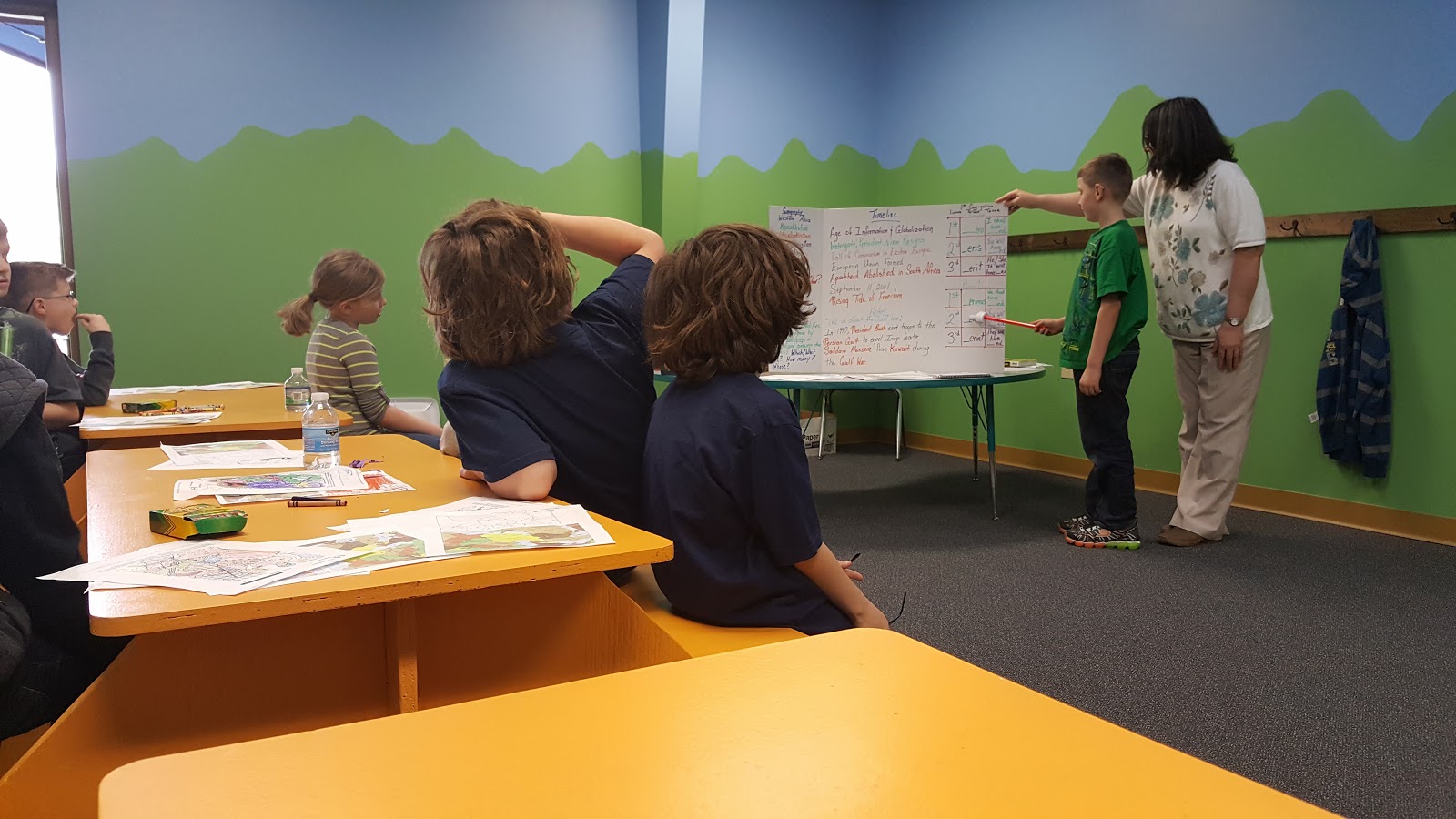


I went to a Masters class with Miranda Guzman and later an Essentials class with Amanda Schmidt.  These older students had opportunities for public speaking, playing games, and summarizing a story.  They were assigned homework in the class that I observed and not a minute was wasted!!!  They utilize IEW with Andrew Pudewa.  More on the Essentials group with my next post…..


Tuesday, April 4, 2017

Notes on Classical Education

As I prepared to attend an open house at our Classical Conversations, I was blown away with how much I do not know about classical education - the stages, the trivium, the terminology, the Latin.  As I researched this, I realized that to do a great review of my day at Classical Conversations Campus in Beckley, I needed to share the thoughts behind this different method of education.  Here are my notes, most of which are from Wikipedia for the preciseness of the information.  Enjoy.  I'll be back soon to discuss the actual visit to the campus.

Stages of our current education system date back to "Classical Education"

  1. Primary education teaches students how to learn (k-12th grades)
  2. Secondary education teaches a mental framework that can contain history, understands basic facts and practices of multiple subjects, and also develops the skills of these subjects (undergraduate degree)
  3. Tertiary education then prepares a person to pursue a profession (graduate education)

Primary education

In classical terms, primary education was the trivium comprising grammar, logic, and rhetoric.

Grammar

Grammar consists of skills such as reading and writing - to acquire as many words and manage as many concepts as possible.

Logic and rhetoric were often taught by the Socratic method. (A form of discussion between individuals, based on asking and answering questions to stimulate critical thinking and to illuminate ideas)

Logic

Logic is the process of correct reasoning and refers to the  middle school aged student, who developmentally is beginning to question and enjoys debating or arguing with others. Practice in logic lets students evaluate arguments. The goal is to train the student's mind not only to grasp information, but to find connections between different ideas, to find why something is true or false.

Rhetoric

Rhetorical debate and composition are taught to high school students, who by this point in their education have the concepts and logic to criticize their own work and persuade others.  The student now learns to articulate answers to important questions in her own words, to persuade others with facts, and to defend ideas against rebuttal.


Wednesday, March 29, 2017

Portfolio Assessment 2017

With the annual assessment season upon the home educators of West Virginia, I'd like to remind us of the new laws that were passed in last year's legislative session.
Home School Legal Defense Association (www.HSLDA.org) posts this information as it relates to the 'Homeschool Modernization Bill' HB4175:
Do I still have to assess my students annually? Yes. Homeschooled students must be assessed annually in the areas of reading, language, mathematics, science, and social studies.Do I have to submit the assessment to the local superintendent? Yes, but not annually as before. Under the new law the parent or legal guardian must submit the results of the academic assessment to the superintendent for grades 3, 5, 8, and 11.
When do I have to submit assessments? The assessments must be submitted by June 30 of the year they are administered for 3rd, 5th, 8th, and 11th grades. How long do I have to keep assessment results? A parent or legal guardian must maintain copies of the academic assessment for three years.
Do I still have the portfolio option? Yes. Parents still have the same 4 assessment options: 1) a nationally normed standardized achievement test 2) the current state testing program 3) certified teacher portfolio review 4) an alternative assessment mutually agreed upon by the parent and superintendent.
So each year an assessment needs to be accomplished as always; however, with the new law, these assessment forms from your reviewer need to be turned into the board of education after the following grades:  3rd, 5th, 8th, and 11th grades.

I'm scheduling portfolio assessments now and hope to conclude by June 30th.  Does the assessment need to be completed only after you are finished with the school year?  No, I understand that many homeschool families school year around and/or start after Labor Day, so they naturally go later.  Each school is different, and I evaluate as such.


Enjoy some of these pictures of our recent hands-on learning.  Don't forget to include your pictures by phone, flash drive, or printed.  


Todd Ensign and the 3D computer at NASA IV&V center, Fairmont, WV


Clay Center, Homeschool Appreciation Day

Simulation of a CT scan


Light Wave Experiment

Clay Center, My Town area

STEM labs

Friday, November 4, 2016

Man's Wisdom Blocks Faith - by Reimar Shultze

I will destroy the wisdom of the wise and will bring to nothing the understanding of the prudent. -1 Cor 1:19kjv


The most beautiful illustration of the text is Moses.  Moses had the wisdom of the wise.  He had learned all the wisdom of Egypt, studying biology, philosophy, political science, mathematics, geometry, and world history.  Yet what did God need of all that wisdom to make Moses a deliverer?  The answer:  none of it!
God had to put Moses into a forty year re-education program in the very wilderness where he was later to lead the nation of Isreal.  God had to teach Moses the wisdom of the Lord; lessons of utter dependence upon Him and of not leaning upon his own understanding.
When it was time for Moses to lead Isreal into the wilderness, he had to forget what he knew about the land's desolate agricultural state.  He had to forget about its impossible climate of scorching heat during the day and sometimes freezing temperatures at night.  He had to forget about eh lack of lakes and rivers.  He had to forget about protesting to God, "This will not work!  I have been there."  Moses' faith enabled him to take Isreal into a wilderness that, barring quick and powerful miracles, could cause them to perish within a week's time.
Moses had to exchange the wisdom of the wise with the wisdom of God to make his faith work.  So, God sent a cloud to cool His people by day and a pillar of fire to warm them by night.  He sent bread from the sky and water from the rocks.  He made for Isreal a place of life in an otherwise uninhabitable wilderness.  But God could not do that until He had a man whose earthy wisdom could be laid aside in order to favor the wisdom of God.  So, whose wisdom are you operating on:  the wisdom of man or the wisdom of God. -Reimar Shultze
My children that I have homeschooled.
Is it a waste of time to learn biology, philosophy, political science, math, geometry or world history?  NO!  But what is important is that your child knows that the most important aspect of his or her education is FAITH IN GOD!  Knowing that God will provide what we need, when we need, it is the biggest lesson parents can give children.  Today, operate in the wisdom of God, not man.  

Friday, October 7, 2016

Facebook Live

I have not been able to post like I would like on every single topic I'm passionate about. Life with new kiddos has gotten in the way.  I want to post about that later.

I have done a few Facebook Live posts.  One was "Simple Starting Points" for new homeschoolers. The other so far was "Rest!"

Please feel free to look at these and leave feedback. I'd like to vlog here as well!!!  That may be down the pike!  Anyway, here is a link to the Facebook Page.  Make sure to like it....

Homeschooling Consultation Facebook Page


Friday, July 15, 2016

Physical Education II

Our area college has a branch called Alpine Ministries.  Alpine Ministries  provides opportunities  for physical education.   Be creative with exercise and have fun like we did one day during the winter.  Rock wall climbing is a great way to practice a skill and get the heart rate going.  Another advantage is having your friends cheer you on as you climb.  

Friday, July 8, 2016

Physical Education

What do you do for PE?  Physical Education?  Education?  I teach health.  Is that good enough?

For homeschool purposes, just get out and move.  Teach your children to be active.  Share a passion for walking the neighborhood (after school hours or truant officers may be called) or running.  Did you play baseball in your youth?  Play that with your child.  Swimming at the YMCA would count as PE.  It need not be formal, but needs to be purposeful.  Have fun.

Here are a few pics of our PE one day:

https://plus.google.com/101815668043817292958/stories/41a7c10b-e9a4-3d23-bfaa-3a1b72262b9714b108599d2?authkey=CM2ZzbvUusD7aA

What activities do you enjoy for PE?